Nature
Crystal River Manatees: Why They Come, How Many, and How They Live
Crystal River’s manatees are there for one reason: warm water. When the Gulf turns cold in winter, Florida manatees go looking for heat, and Kings Bay, the spring-fed head of the Crystal River in Citrus County, holds more than 70 springs that run at 72 degrees all year. The Southwest Florida Water Management District calls it the largest natural winter refuge for manatees on Florida’s Gulf Coast. The U.S. Fish and Wildlife Service counts over 600 manatees migrating into Kings Bay each winter, and it runs the only national wildlife refuge in the country created specifically to protect them.
That combination of clear, shallow springs, crowds of manatees and a town built around the water is why Crystal River calls itself the Manatee Capital of the World. Below: why the animals come, how many you can expect and when, what a manatee actually is, the threats it faces, and how a fishing creek turned into a federal refuge.
Why manatees come to Crystal River
Manatees are tropical animals living at the northern edge of their range. The Florida Fish and Wildlife Conservation Commission (FWC) explains that they cannot tolerate prolonged exposure to water below 68°F. Stay too long in colder water and a manatee loses body heat and stops digesting its food properly. FWC calls the result cold stress, and it can kill.
So every winter the Gulf manatees retreat to fixed points of warmth. Some of those are power plant outfalls; FWC estimates about 60% of the population now depends on industrial warm water in winter. The rest use natural springs, and Crystal River has the best set on the Gulf side of the state.
The water district’s figures explain why:
- More than 70 springs feed Kings Bay, the second largest springs group in Florida after Wakulla Springs near Tallahassee.
- The water is 72 degrees year-round, drawn from the limestone aquifer. Many of the springs are 20 to 30 feet deep.
- The Gulf can drop to around 50 degrees in the colder months, so the gap between bay and sea is large.
The refuge puts it simply: manatees come to the springs to conserve the energy they need to survive the cold Gulf. The animals in Kings Bay are not there to feed or socialize; many are resting, and that shapes every rule about how people may approach them.
How many manatees, and when
Numbers depend on who is counting and over what area:
- The refuge says over 600 manatees migrate to Kings Bay each winter.
- The water district says manatees are present all year and several hundred can be seen in winter.
- Citrus County’s tourism office puts the winter total at between 500 and 1,000 for the wider county, including Homosassa, and says up to 100 stay through the summer.
The refuge’s biologists fly over Kings Bay every month to count manatees, and the numbers swing with the weather rather than the calendar. The refuge’s manatee season runs from November 15 to March 31, when its seven warm-water sanctuaries are in force. Within that window, the City of Crystal River’s Three Sisters Springs Center says the best viewing comes with cold fronts and high tides, and that your best chance of manatees inside Three Sisters Springs is a cold winter day when the Gulf is below 68 degrees.
Outside the season the herd thins out. FWC notes that in warm weather manatees leave the sanctuaries and spread along the coast, so a summer sighting may take some travel and luck. Our Crystal River weather guide sets the manatee season against the temperatures month by month.
Florida’s manatee population
Crystal River’s winter gathering is a slice of a statewide population that FWC surveys from the air. Its third statewide abundance survey, flown over the west coast on December 1-15, 2021 and the east coast a year later, estimated:
- 8,350-11,730 Florida manatees statewide for 2021-2022.
- 3,960-5,420 on the west coast, the population that winters at Crystal River.
The previous survey, in 2015-2016, gave 7,520-10,280. FWC is careful about what that means: the two ranges overlap, so the population could have risen or fallen, and it does not recommend reading a trend from the surveys alone. The ranges are wide because manatees spend much of their time submerged, and observers in aircraft miss some of them.
What a manatee is
The Florida manatee is a subspecies of the West Indian manatee, a large, gray, plant-eating marine mammal. FWC’s species profile gives these measurements:
- Length: typically 9-10 feet from snout to tail.
- Weight: around 1,000 pounds, though some grow to over 13 feet and more than 3,500 pounds.
- Newborn calves: around 60-70 pounds.
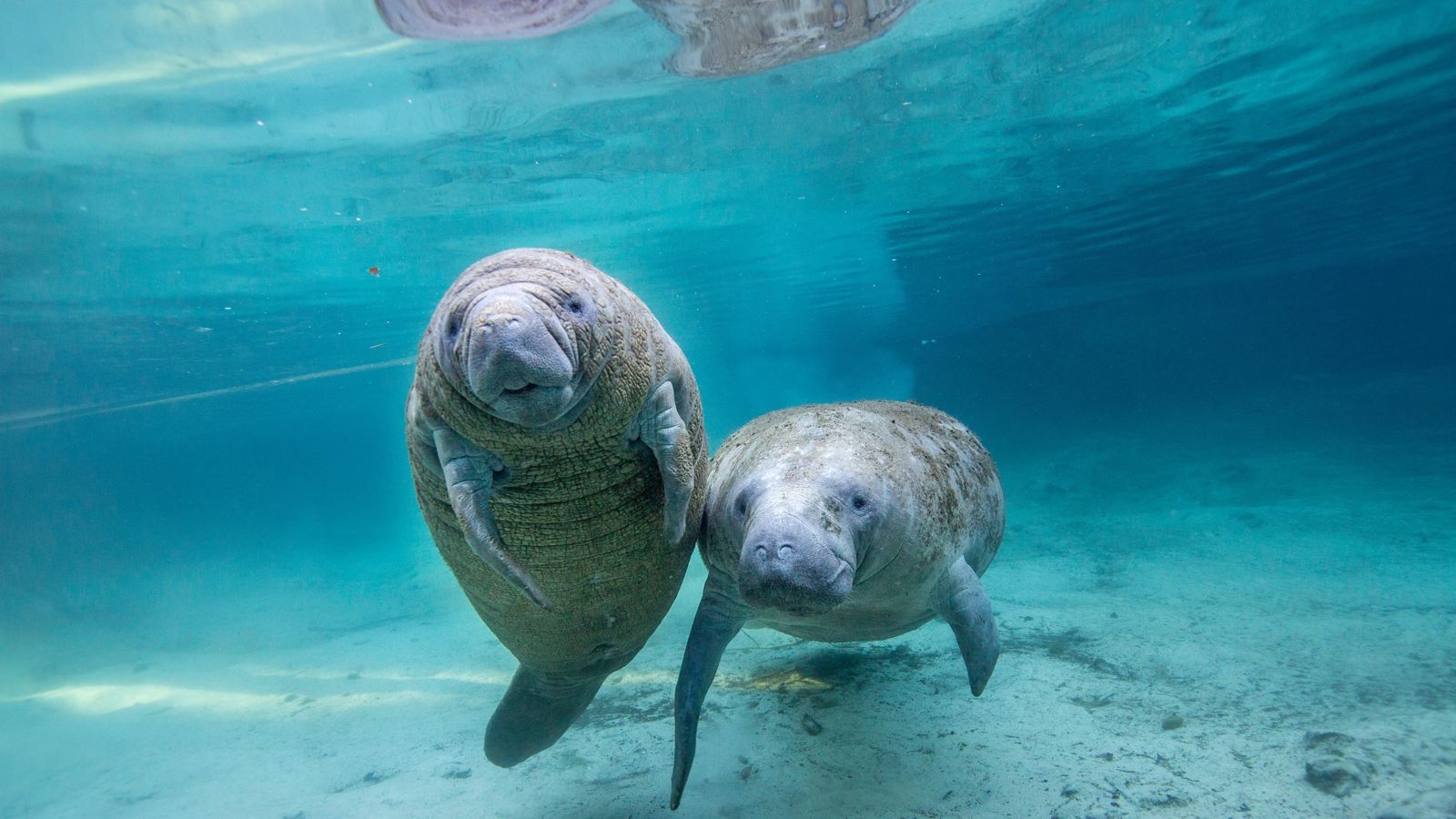
Up close, a manatee rarely looks gray. Algae grows on the back and tail and turns the skin green or brown, and coastal animals carry barnacles that leave round scars. A move from salt water into fresh water clears those hitchhikers off, one small benefit of a winter in the springs.
The details reward a slow look:
- Nostrils sit on top of the snout and close with valves underwater.
- The eyes are small, with a membrane that can cover them.
- The ears are small openings with no external lobes.
- The lips are a flexible pad that pushes food into the mouth.
- The teeth are all molars. Manatees have no front teeth, and their molars form at the back of the jaw, move forward and fall out, replaced throughout life, an adaptation to plants that grow in sandy, abrasive sediment.
Two front flippers steer and hold food; a broad, flat, paddle-shaped tail does the swimming.
A day in a manatee’s life
Manatees are sometimes called sea cows, and grazing is most of what they do. FWC says they spend up to eight hours a day feeding and eat up to ten percent of their body weight in vegetation daily. They will eat all of Florida’s seagrasses, including manatee grass, turtle grass and shoal grass, and freshwater plants such as eelgrass and coontail.
The rest of the day is mostly rest. A manatee rests from 2 to 12 hours a day, either hanging near the surface or lying on the bottom of a shallow spot, often for several hours at a stretch. That is what you are most likely to see in a spring on a cold morning: still gray shapes on the sand, surfacing slowly to breathe.
Breathing sets the rhythm:
- When active, a manatee surfaces every three to five minutes.
- When resting, it can stay down for up to 20 minutes.
- At the surface, often only the snout breaks the water.
They look slow, but they are strong swimmers and can reach 15 miles per hour in short bursts. A resting manatee that is startled awake can bolt, which is one reason FWC asks people near them to keep noise and splashing down.
Calves and family life
Outside the winter refuges, FWC describes manatees as semi-social. They travel alone or in loose groups, socialize when they meet, and gather in numbers mainly at warm-water sites. The one lasting bond is between a mother and her calf.
Their breeding is slow:
- Females have their first calf between four and seven years old.
- Gestation lasts 13 months.
- One calf every three to five years is the average.
- Calves stay with their mothers for up to two years.
- Births can happen at any time of year but usually peak in spring.
Slow breeding means losses are hard to replace. Of the wild manatees that reach adulthood, FWC expects only about half to survive into their early 20s. In captivity they live far longer: more than 65 years. FWC’s list of viewing sites records Snooty, the oldest known manatee in the world, who lived at a Bradenton aquarium from 1948 to 2017, reaching 69.
If you see a small manatee pressed against a large one in Kings Bay, it is almost certainly a calf with its mother, and separating the two is one of the specific acts the refuge prohibits.
Cold stress: why winter is the dangerous season
For a manatee the springs are not a luxury. FWC’s habitat page explains that warm-water sites must be consistent and reliable for manatees to come back to them year after year, and that the loss of warm-water habitat is a serious long-term threat. Two worries stand out:
- Spring flow. Pumping water from the aquifer for human use can reduce the warm water a spring delivers.
- Power plants. Many may be retired in coming years, and FWC warns that losing them could raise cold-stress deaths unless restored natural springs are ready to take the animals.
That is why Crystal River matters beyond its own herd. The refuge closes its sanctuaries from November 15 to March 31, when manatees need water above 68 degrees Fahrenheit to survive, and in extreme cold it may temporarily close Three Sisters, House and Jurassic springs or widen the permanent sanctuaries, to give the extra animals room. The springs are, quite literally, life support.
Threats beyond the cold
FWC names collisions with boats and the loss of warm-water habitat as the two main threats. Manatees feed and rest in shallow water, right where boats run, and they are hurt by propellers, by hulls and by the lower unit of motors. Other dangers on FWC’s list:
- Habitat loss, as coastal development and pollution destroy seagrass beds.
- Entanglement in fishing line and crab trap lines.
- Crushing by large ships, or in flood gates, canal locks and culverts.
- Disease, natural disasters and red tide.
The worst recent losses were not at Crystal River but on the Atlantic coast. FWC records an unusual mortality event from December 1, 2020 to April 30, 2022, when 1,255 manatee carcasses were documented and 137 manatees rescued. Investigators found the cause was starvation: seagrass in the Indian River Lagoon had died off, and manatees wintering near warm water had nothing to eat. Of those deaths, 1,039 came in the winters of 2020-2021 and 2021-2022, when cold added to hunger.
Over two winters of a feeding trial, staff and volunteers supplied at least 600,000 pounds of leafy greens. The last starvation death linked to lack of forage was in March 2023, and the event was closed on March 14, 2025. It is a reminder that warm water alone is not enough; manatees also need food near their winter refuges.
How Kings Bay became a refuge
The springs were not always protected. The refuge’s own history of Three Sisters Springs reads like a short history of Florida’s springs in general:
- 1920s: Citrus County fishermen pole wooden skiffs up a long, winding creek from Kings Bay to Three Sisters to fish and fill jugs with spring water.
- 1944: An aerial photograph shows the springs draining to the bay through a shallow, braided, heavily wooded run more than 3,200 feet long.
- 1950s: A local dive shop runs glass-bottom boat tours into the springs.
- 1960s: A canal is dug so boats can reach them.
- 1970s: Most of the trees on the property are cleared and an 8-acre pit, now Lake Crystal, is dug; it collapses into the aquifer at about 40 feet deep.
- 1972: Jacques Cousteau rehabilitates Sewer Sam, the first documented rescued Florida manatee, at Three Sisters Springs.
- 1982: Pilings go in at the spring entrance to limit boat traffic.
- 1983: Crystal River National Wildlife Refuge is established, the only refuge created specifically for the Florida manatee.
The property itself was meant for condos and townhouses, with the spring water to be bottled and sold. In 2008 the Friends of Crystal River NWR Complex began a campaign to save it, and a partnership of state, federal and local bodies bought it for $10.5 million, about two million less than its market value. The refuge acquired it in 2010, and Three Sisters Springs opened to the public in November 2014. It is now jointly owned by the City of Crystal River and the Southwest Florida Water Management District and managed as part of the refuge. In 2012 the whole of Kings Bay was designated the Kings Bay Manatee Refuge.
The springs that make it possible
Kings Bay is a 600-acre bay at the head of the Crystal River, a tidal river that runs to the Gulf. The water district describes it as a first-magnitude spring system fed by a springshed of approximately 310 square miles, much of Citrus County. Most of the springs are in the eastern half of the bay, including Hunter, Tarpon Hole and Three Sisters.
The bay is shallow, on average 3 to 10 feet deep, and oddly mixed. In the north the water flushes quickly and the springs are fresh; in the more open south the water is estuarine and many springs are brackish. That is why you can find largemouth bass and snook, mullet and tarpon in the same bay, along with cormorants, stingrays and even bull sharks.
Three Sisters itself is a cluster of vents in a clover-like pattern: Pretty Sister, Big Sister (sometimes called Deep Sister) and Little Sister. Where their short run meets the canal, a few more vents go by the name Idiots Delight.
The bay has been through hard times. Between 1950 and 1980 dredged canals, seawalls and building changed how water moved and replaced much of the natural shore. Invasive plants introduced in the 1960s choked the channels until storm surges in the 1990s and early 2000s nearly wiped them out, after which algae such as Lyngbya spread. The state now lists Crystal River/Kings Bay as both an Outstanding Florida Spring and an Outstanding Florida Water, and community groups have been replanting native underwater plants, the food manatees need close to their winter refuge.
Protected by law
The Florida manatee is federally listed as Threatened, and the IUCN lists it as Vulnerable. FWC sets out the legal layers:
- The Marine Mammal Protection Act of 1972 and the Endangered Species Act of 1973 make it illegal to harass, hunt, capture or kill a manatee.
- The Florida Manatee Sanctuary Act of 1978 makes it unlawful to annoy, molest, harass or disturb one, intentionally or negligently.
- Penalties: up to a $500 fine and/or 60 days in jail under state law, and up to $50,000 and/or one year in prison under federal law.
FWC adds a detail that sets Crystal River apart: Crystal River and Kings Bay is the only area in Florida where swimmers are monitored around manatees. The full list of prohibited acts, the seven sanctuaries and the temporary no-entry zones are in our guide to Three Sisters Springs and the manatee rules.
Seeing manatees without disturbing them
The Fish and Wildlife Service asks for passive observation: do not initiate contact, stay calm, and watch from a distance at the surface. FWC adds that swimmers should use snorkel gear and float, because the sound of scuba bubbles may drive manatees away. In practice there are three ways to see them:
- From land. In winter the most popular above-water viewpoint is the Three Sisters Springs boardwalk. At nearby Ellie Schiller Homosassa Springs Wildlife State Park, an underwater observatory lets you watch wild manatees that reach the spring in winter, and resident manatees live there all year.
- From a boat or kayak, outside the sanctuaries. Much of the refuge can only be reached by water, and the refuge itself does not run tours; it issues Special Use Permits to businesses on Kings Bay.
- In the water, on a snorkel tour or from your own vessel, following the passive-observation rules.
Our guide to swimming with manatees compares the snorkel tours, viewing boats and kayaks, and the Orlando and Tampa guide covers getting there. If you find a manatee that is injured, sick or in distress, call the FWC wildlife emergency hotline on 1-888-404-3922.
Frequently asked questions
Why are there so many manatees in Crystal River?
Because of the springs. Kings Bay has more than 70 of them, running at 72 degrees all year, while the Gulf can drop to around 50 degrees in winter. Manatees cannot tolerate long exposure to water below 68°F, so they gather in the warm, shallow springs until the cold passes.
When is the best time to see manatees in Crystal River?
The refuge’s manatee season runs from November 15 to March 31. The City of Crystal River says the best viewing comes on cold-front days and at high tide in that window. Some manatees stay all year, but in summer they disperse along the coast.
How many manatees are in Crystal River?
The refuge counts over 600 migrating to Kings Bay each winter. Citrus County’s tourism office gives 500 to 1,000 for the wider county, with up to 100 staying through summer. Counts vary with the weather.
How big do manatees get?
Adults are typically 9-10 feet long and around 1,000 pounds. FWC says some grow to over 13 feet and more than 3,500 pounds. Calves weigh around 60-70 pounds at birth.
Are Florida manatees endangered?
The Florida manatee is federally listed as threatened and is protected by the Marine Mammal Protection Act, the Endangered Species Act and the Florida Manatee Sanctuary Act. Harassing one is a crime under both state and federal law.