Places
Things to Do in Crystal River: Springs, Mounds, Scallops and More
Crystal River is famous for one thing, swimming with manatees, and most visitors come for a morning on the water and leave by lunch. That is a pity, because the town sits in the middle of some of the best of old Florida. Kings Bay, at the head of the river, holds more than 70 springs. Within a short drive are a 1,600-year-old ceremonial mound complex, a 27,500-acre coastal preserve, a spring where you can watch manatees through underwater windows, and the mermaids of Weeki Wachee. In summer the Gulf offshore fills with scallops you can gather by hand.
Below are the best things to do in Crystal River beyond the manatee swim, roughly from the water outwards, with the prices, hours and rules each place publishes. For the swim itself, our guide to swimming with manatees compares the tours.
Walk the Three Sisters Springs boardwalk
Three Sisters Springs is the most famous spot on Kings Bay and the one place where you can see it all without getting wet. The property covers 57 acres, with a boardwalk around the springs and over 2 miles of easy trails through the wetlands. The Fish and Wildlife Service manages it as part of the Crystal River National Wildlife Refuge, and the City of Crystal River runs land access.
You cannot drive in. The Three Sisters Springs Center, at 917 Three Sisters Springs Trail, sells tickets that include a shuttle running continuously from 8:30am to 4:30pm, with the last ticket sold at 3:30pm. Adults pay $12.50 from April 1 to November 14 and $20.00 from November 15 to March 31; children 6-15 pay $7.50.
What to look for:
- Manatees in winter. In the cold months the boardwalk is the most popular above-water viewing spot in the refuge.
- The three sisters. Pretty Sister, Big Sister and Little Sister form a clover of spring vents, and the clear water lets you see straight to the sand.
- Birds. Over 100 species have been documented at Three Sisters Springs, and the refuge publishes a bird list by season.
- Wildlife to respect. Alligators and venomous snakes live in the wetlands, so stay on the trails.
There is no swimming from the boardwalk and no water access from the land. Our guide to Three Sisters Springs and the manatee rules covers tickets and the season in detail.
Visit the refuge Visitor Center
The Crystal River National Wildlife Refuge was established in 1983 as the only refuge created specifically for the Florida manatee. Its Visitor Center and Nature Store on Kings Bay is free, with displays on manatees and their habitat and a view over the bay’s islands. It opens 9:00 to 4:00 every day from November 15 to March 31, and 10:00 to 4:00 on weekdays the rest of the year. It is also a stop on the Three Sisters shuttle, so the two combine easily.
Join a ranger program or guided walk
The refuge runs ranger-led programs at Three Sisters Springs every day during manatee season, from November 15 to March 31, and less often from April 1 to November 14. The City of Crystal River adds that Fish and Wildlife Service volunteers lead guided walking tours on the boardwalk in season, and birding tours through the year; ask the volunteers at the boardwalk for the day’s schedule, or call the refuge.
These are the best way to understand what you are looking at. The springs have a long history: fishermen poled skiffs up to Three Sisters in the 1920s, a canal was dug in the 1960s, and the property was saved from a condo development and bought for $10.5 million before opening to the public in November 2014. The volunteers also know where the manatees have been gathering that week. Photography is welcome from the boardwalk and wetland trails, but camera extension poles and drones are not allowed.
Swim and picnic at Hunter Springs Park
Hunter Springs Park is the town’s own spring beach, and the easiest place in Crystal River to get into spring water on your own. About 100 feet offshore is one of the springs that feed Kings Bay, keeping the water at a fairly constant 72°F (22°C) year-round. The park has:
- A small beach and a roped-off swimming area.
- A kayak launch, a boardwalk along the water and a playground.
- Picnic areas with grills, and restrooms.
It opens 8 am to 8 pm from April 1 through Labor Day, 8 am to 7 pm until October 31, and 8 am to 5:30 pm from November 1 through March 31. There are fees to park and launch, paid by card only. Dogs, alcohol, glass and fishing are not allowed, and the city does not rent kayaks there. In the colder months manatees sometimes swim past.
Paddle Kings Bay
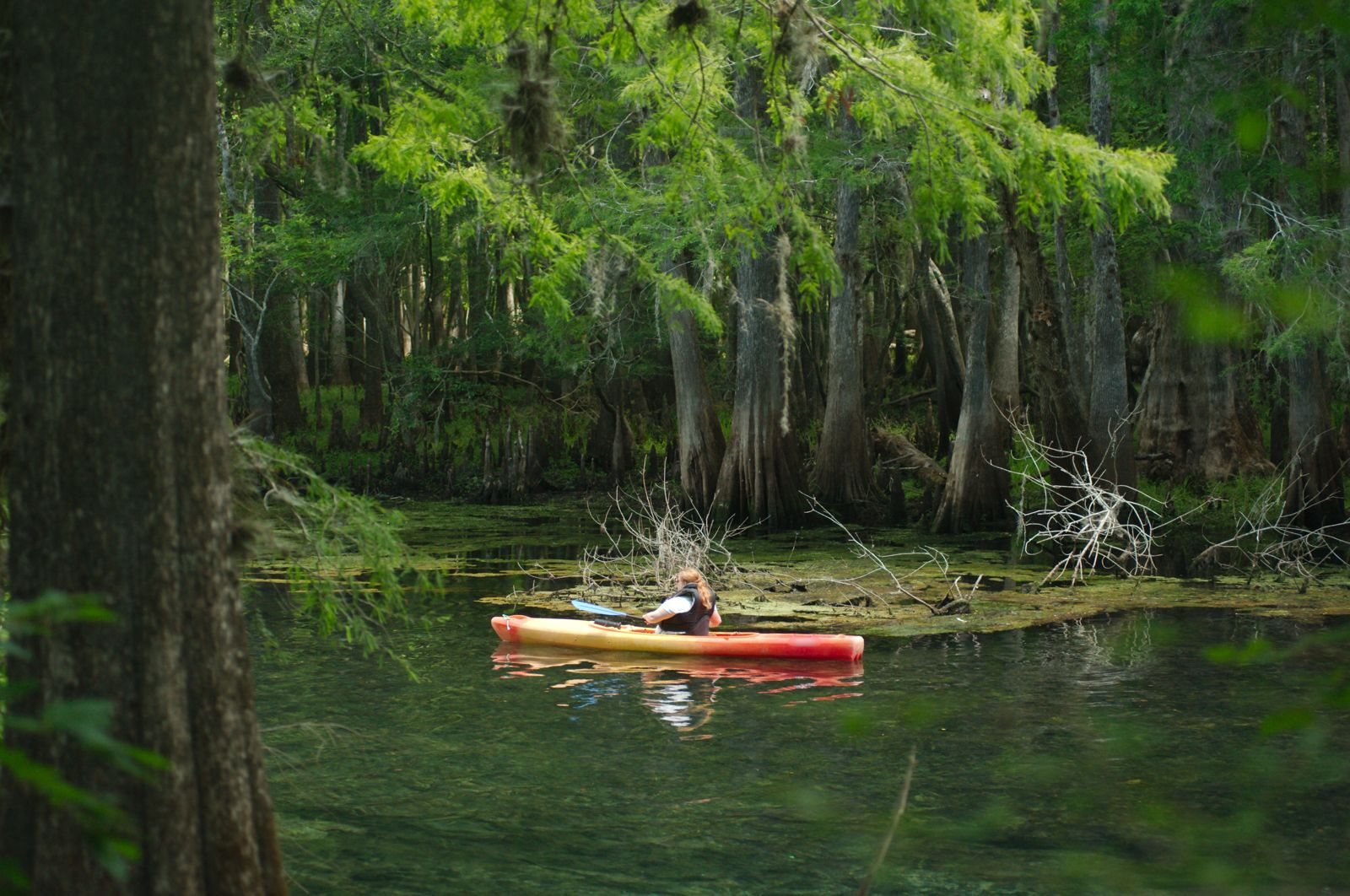
Much of the refuge can only be reached by water, and a kayak or paddleboard is the quietest way to see it. The public launches are at Hunter Springs Park and King’s Bay Park, and outfitters rent boats around the bay. The rules depend on the season:
- April 1 to November 14: paddle craft may enter Three Sisters Springs through the spring run.
- November 15 to March 31: the seven manatee sanctuaries are closed to all activity, and paddle craft may not enter Three Sisters Springs.
- All year: motorized vessels are never allowed inside Three Sisters.
Clear-bottomed kayak tours are a popular way to see the springs from above. If a tour promises Three Sisters Springs, check the date: inside the spring is only possible from April to mid-November.
Snorkel and dive the springs
Snorkeling is a year-round activity in Kings Bay. The water district says many of the river’s springs are 20 to 30 feet deep with very clear water, and the bay holds both freshwater and saltwater fish, from largemouth bass to snook, mullet and tarpon.
For divers, the refuge says the most popular site is King Spring, near Banana Island, open year-round. In manatee season divers stay inside the buoyed “keyhole” or outside the sanctuary. Scuba at Three Sisters Springs is allowed only from April 1 to November 14.
Two refuge requests apply to everyone in the water: stay out of the marked sanctuaries, and do not walk on the bottom, which stirs up sediment and spoils the visibility. FWC adds that near manatees you should float at the surface with a snorkel, because scuba bubbles can drive them away.
See the Crystal River Archaeological State Park
Halfway down the river between the springs of Kings Bay and the Gulf is the oldest attraction in Crystal River. The Crystal River Archaeological State Park protects a 61-acre pre-Columbian site, now a National Historic Landmark, with burial mounds, temple/platform mounds, a plaza and a large midden. The park describes the six-mound complex as one of the longest continuously occupied sites in Florida. For 1,600 years it was a ceremonial center, and as many as 7,500 Native Americans may have traveled there each year to trade and bury their dead.
Paved paths lead around the mounds, and from the top of the temple mound you stand where people stood more than 500 years ago, looking down the river toward the Gulf. The museum has exhibits, artifacts and a video.
- Hours: 8 a.m. to sunset, 365 days a year; museum 9 a.m. to 5 p.m., Thursday to Monday.
- Fee: $3 per vehicle, paid at an honor box with correct change.
- Also: the park is on the Great Florida Birding Trail, and anglers fish from the riverbank.
Explore Crystal River Preserve State Park
Next door is the wild side of the river. Crystal River Preserve State Park covers more than 27,500 acres of scrub, pinewoods, hardwood forest, salt marsh and mangrove islands, much of it untouched. Entry is free, from 8 a.m. to sunset, 365 days a year.
- Walk or ride the 7-mile loop trail, open to hikers, joggers and mountain bikers.
- Paddle the estuary, where fresh spring water meets the Gulf.
- Take the park’s boat tour, which it describes as an eco-heritage trip along the river.
The preserve and the archaeological park share a stretch of river and make a natural half-day together.
Watch manatees underwater at Homosassa Springs
In neighboring Homosassa, Ellie Schiller Homosassa Springs Wildlife State Park is the best way to see manatees without a boat. Its Underwater Observatory lets you walk beneath the surface of a first-magnitude spring and watch fish and manatees through the windows. FWC notes that wild manatees reach the spring headwaters in winter and that resident manatees live there all year.
The park is also a showcase for animals that cannot survive in the wild: Florida panther, red wolf, whooping crane, black bear, bobcat and alligators, along a 1.1-mile boardwalk trail. Homosassa Springs was a railroad stop in the early 1900s, and in 1924 a visitor called it the most beautiful river and springs in the world.
- Hours: 9 a.m. to 5:30 p.m.; ticket counters close at 4:45 p.m.
- Fees: adults (13+) $13, children 6-12 $5, 5 and under free.
- Note: from February 4, 2026 the park’s shuttle boats were suspended because of low water. Check before you go.
Our Orlando and Tampa guide shows how Homosassa fits into a day trip.
Meet the mermaids at Weeki Wachee
Further afield, Weeki Wachee Springs State Park is one of the best-known symbols of old Florida tourism. Its mermaids perform in water from a first-magnitude spring, and in 2007 explorers confirmed Weeki Wachee as the deepest known freshwater cave system in the United States. You can also kayak down the spring run.
- Hours: 9 a.m. to 5:30 p.m.
- Fees: $13 for adults, $8 for children 6 to 12.
- Note: the daytime Wilderness River Cruise was paused from December 12, 2025 because of low water, and the park does not refund tickets for weather cancelations.
Go scalloping in summer
From July to September, Crystal River turns from manatees to scallops. Bay scallops live in the eelgrass on the shallow Gulf flats, and gathering them is a snorkeling trip: you float, spot them on the bottom and pick them up by hand. Citrus County’s tourism office says the beds are about 2-3 miles offshore.
FWC sets the rules:
- Season: July 1 through Sept. 24 for Levy, Citrus and Hernando counties, including Crystal River and Homosassa.
- Daily bag limit: 2 gallons of whole scallops in shell or 1 pint of meat per person.
- Per vessel: no more than 10 gallons whole or 1/2 gallon of meat.
- Shells: do not dump them in the Crystal River or Homosassa River, where piles hurt swimmers and seagrass.
A boat with swimmers in the water must fly a dive flag at least 20 by 24 inches, and swimmers should stay within 300 feet of it. A fishing license is required for boaters between 16 and 64, with exceptions; tour operators usually supply it. Seasons can change at short notice: in 2026 FWC closed the Pasco Zone, just south of Hernando County, from August 6 because of toxic algae. Check FWC’s page before you go.
Fish the bay and the coast
Kings Bay is unusual: fresh springs in the north, brackish ones in the south, and a tidal river to the Gulf. The water district lists largemouth bass, snook, mullet, catfish and tarpon in the same bay. Citrus County’s tourism office points bass anglers to the Tsala Apopka chain of lakes at Inverness. Remember that fishing is not allowed at Hunter Springs Park, and that a license is required for most adults.
Go birding and cycling
- The islands: the refuge says Buzzard, Parker and Banana islands in Kings Bay are home to bald eagles, osprey, wood storks and many shore birds.
- Three Sisters Springs: over 100 species recorded, and the refuge holds a bird count every January.
- The archaeological park: on the Great Florida Birding Trail, at the edge of a coastal marsh.
- On a bike: the tourism office recommends the Withlacoochee State Trail inland, and the 7-mile loop at Crystal River Preserve is open to mountain bikes.
Is Crystal River worth visiting?
For manatees, yes, without much competition: the water district calls Kings Bay the largest natural winter refuge for manatees on Florida’s Gulf Coast, and FWC says it is the only area in Florida where swimmers are monitored around them. But the case for staying longer than a morning is the rest of this list. The springs are 72 degrees all year, the mounds and the preserve are quiet and cheap, and Homosassa and Weeki Wachee add two classic Florida springs within reach.
A full day might look like this:
- Early morning: a manatee swim or viewing cruise on Kings Bay.
- Late morning: the Three Sisters boardwalk and the refuge Visitor Center by shuttle.
- Afternoon: the archaeological park and a walk in the preserve, or the drive south to Homosassa’s underwater observatory.
The best months for each activity are set out in our Crystal River weather guide, and the animals themselves in our article on Crystal River’s manatees.
Frequently asked questions
What is there to do in Crystal River besides swimming with manatees?
Walk the Three Sisters Springs boardwalk, swim at Hunter Springs Park, paddle Kings Bay, snorkel or dive King Spring, visit the Crystal River Archaeological State Park and Crystal River Preserve State Park, see manatees underwater at Homosassa Springs, and go scalloping from July 1 through Sept. 24.
Can you swim in the springs in Crystal River?
Yes. Hunter Springs Park has a roped-off swimming area beside a spring that stays near 72°F, and snorkeling is allowed year-round in Kings Bay outside the marked sanctuaries. You cannot enter Three Sisters Springs from the land; swimmers must arrive by boat or kayak.
Where can you see manatees without getting in the water?
The Three Sisters Springs boardwalk in winter, and the Underwater Observatory at Ellie Schiller Homosassa Springs Wildlife State Park, where resident manatees live all year. A viewing cruise on Kings Bay is the third option.
How much does it cost to visit Crystal River’s parks?
Three Sisters Springs is $12.50 for adults in summer and $20.00 in winter, including the shuttle. Homosassa Springs is $13 for adults, Weeki Wachee $13, the archaeological park $3 per vehicle, and Crystal River Preserve State Park is free.
When is scallop season in Crystal River?
FWC’s season for Levy, Citrus and Hernando counties runs from July 1 through Sept. 24, with a daily limit of 2 gallons of whole scallops or 1 pint of meat per person.